Dermal Filler Cannula Sizes: A Complete Gauge Guide
Dermal filler cannula sizes typically range from 18G to 27G, with the right choice depending on the treatment area, the viscosity of the product being injected, and how deep the target tissue plane sits. Thicker, higher-viscosity fillers generally need a larger-bore cannula, while finer, more delicate areas call for a smaller gauge.
Dermal Filler Cannula Sizes for Lip Fillers
Lip filler is most commonly delivered with a 25G cannula, a size fine enough to move comfortably through the lip’s soft tissue while still allowing an appropriately viscous filler to pass through without excessive injection pressure.
Some practitioners prefer a slightly finer 27G cannula for very precise, low-volume lip work, particularly around the vermillion border, though this depends on the specific filler’s viscosity and the injector’s own technique.
Dermal Filler Cannula Sizes for Lip Fillers
Lip filler is most commonly delivered with a 25G cannula, a size fine enough to move comfortably through the lip’s soft tissue while still allowing an appropriately viscous filler to pass through without excessive injection pressure.
Some practitioners prefer a slightly finer 27G cannula for very precise, low-volume lip work, particularly around the vermillion border, though this depends on the specific filler’s viscosity and the injector’s own technique.
[Internal link opportunity: link “lip filler” to your lip filler treatment/guide page]
Dermal Filler Cannula Sizes for Cheek Fillers
Cheek augmentation typically uses a larger-bore cannula, commonly 22G or 25G, to accommodate the thicker, higher-viscosity fillers used for deep structural volume in this area, such as Revolax Sub-Q or comparable products.
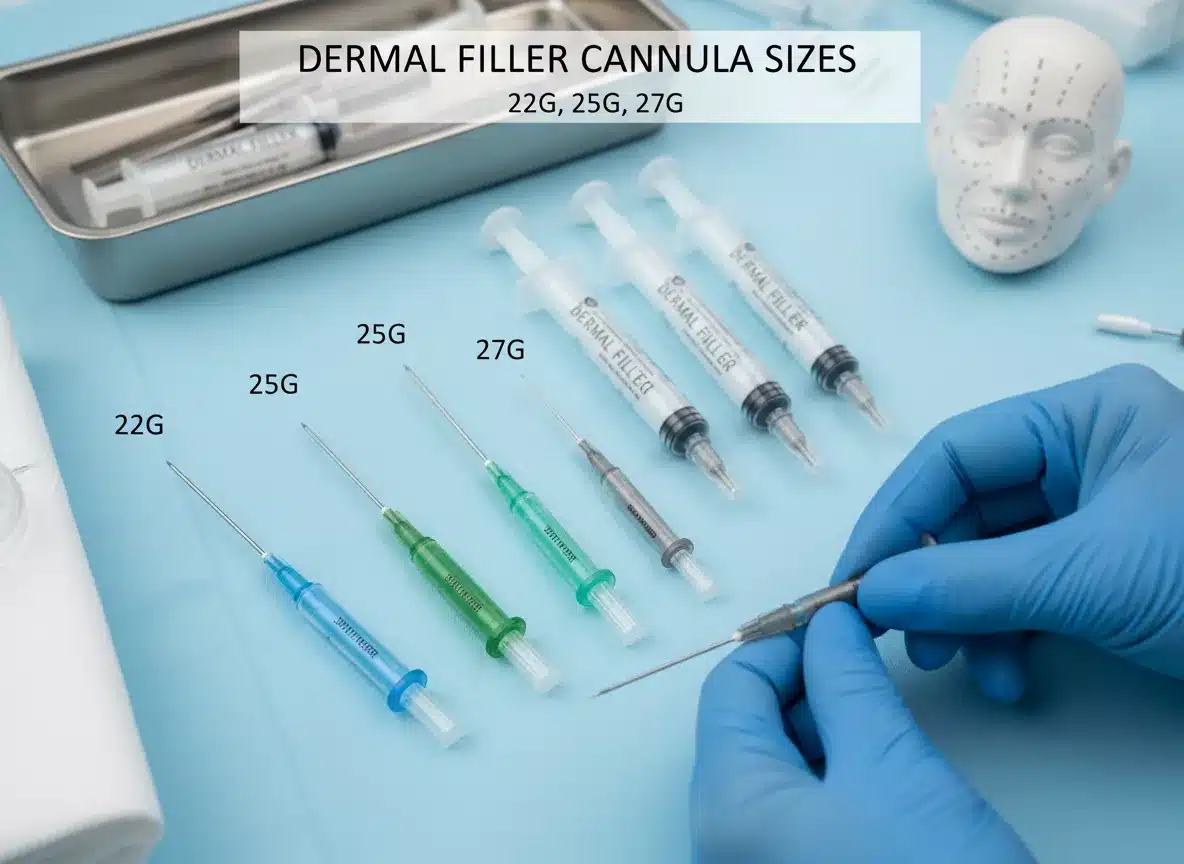
- 22G: larger bore, suited to denser, high-viscosity fillers and larger treatment volumes
- 25G: mid-range, versatile across cheeks, temples and mid-face
- 27G: fine gauge, suited to lips and more delicate, lower-volume areas
[Internal link opportunity: link “cheek augmentation” to your cheek filler treatment/guide page]
What Gauge Cannula Is Used for Dermal Fillers?
Gauge is an inverse scale, so a smaller number means a larger-diameter cannula. Aesthetic practice generally uses cannulas between 18G and 27G, with 22G to 25G covering most face and body treatment areas, and 27G reserved for the finest, most delicate work.
The correct gauge for a given treatment depends on three things: the viscosity of the product, the depth of the target tissue plane, and the practitioner’s own technique and comfort with a given cannula size for that specific procedure.
What Is a Blunt Cannula?
Understanding blunt cannula design is part of understanding dermal filler cannula sizes more broadly. A blunt cannula has a rounded, non-cutting tip, unlike a hypodermic needle’s sharp bevel. This design lets the cannula glide through tissue and gently displace structures such as blood vessels rather than piercing them directly, which is the basis of its safety advantage in vessel-dense areas.
Cannulas are typically inserted through a single small entry point made with a needle, then advanced through the treatment area in a fanning technique, which also reduces the number of skin punctures compared with using a needle for every injection point.
Why Are Cannulas Used Instead of Needles?
The main reason is safety in vessel-dense areas. A 2021 study published in JAMA Dermatology, involving 370 board-certified dermatologists, found a vascular occlusion rate of 1 in 6,410 injections using needles compared with 1 in 40,882 using cannulas, a meaningful difference in a complication that can have serious consequences.
Beyond vascular safety, cannulas are also associated with less bruising and faster patient recovery, since a single entry point and blunt tip cause less trauma to surrounding tissue than repeated needle punctures across a treatment area.
How Do You Choose the Right Dermal Filler Cannula Size?
Product viscosity is the starting point. Thicker, higher cross-linked fillers require a larger-bore cannula to pass through without excessive force, while thinner, lower-viscosity products can move comfortably through a finer gauge.
Treatment depth and area come next. Superficial work, like fine lines or the delicate lip border, generally calls for a finer cannula, while deep structural volume work in the cheeks or jawline typically needs a larger bore to deliver the product efficiently and accurately.
Are Cannulas Available in Different Lengths?
Length is the other half of dermal filler cannula sizes. Cannula length typically varies from around 25mm for small, localised areas up to 70mm or more for treatments that need to cover a wider area from a single entry point, such as the cheek or jawline.
Length and gauge are chosen together, not independently, since a longer cannula in a very fine gauge can be harder to control and more prone to bending, while a shorter cannula limits how far a single entry point can reach.
What Happens If You Use the Wrong Dermal Filler Cannula Size?
A cannula that’s too fine for a given product can force the practitioner to apply excessive pressure to move the filler through, which increases the risk of the cannula tip damaging tissue as it’s pushed forward, and can make the injection itself far less comfortable for the patient than it needs to be.
A cannula that’s too large for the treatment area, on the other hand, creates a bigger entry wound than necessary and can make precise, controlled placement harder in delicate zones like the lips or under the eyes. Matching size to both the product and the anatomy isn’t a minor technical detail — it directly affects patient comfort, bruising, and the accuracy of the final result.
How Many Cannulas Should a Clinic Keep in Stock?
Most single-practitioner clinics find that stocking three to four gauge and length combinations covers the large majority of treatments, typically a 25G at a shorter length for lips and finer work, a 22G or 25G at a longer length for cheeks and jawline, and a 27G for the most delicate periorbital treatments.
Busier multi-practitioner clinics, or those offering a wider treatment menu, often keep a slightly broader range of dermal filler cannula sizes on hand to avoid a practitioner having to reschedule a patient because the exact size needed for that day’s treatment plan isn’t currently in stock.
[Internal link opportunity: link “stock” or “order cannulas” to your product/shop page]
Frequently Asked Questions
Practical answers to the dermal filler cannula sizes questions that come up most often when practitioners are stocking or choosing cannulas.
What cannula size is used for lip fillers? Most commonly 25G, sometimes 27G for very fine, precise work.
What cannula size is used for cheek fillers? Typically 22G or 25G, to accommodate thicker, higher-viscosity fillers.
What gauge cannula is used for dermal fillers? Generally 18G to 27G across aesthetic practice, with 22G to 25G covering most areas.
What is a blunt cannula? A cannula with a rounded, non-cutting tip designed to glide through tissue and displace, rather than pierce, blood vessels.
Why are cannulas used instead of needles? Primarily for safety, with published data showing a meaningfully lower vascular occlusion rate than needles.
How do you choose the right dermal filler cannula size? By matching gauge and length to the product’s viscosity and the treatment area’s depth.
Are cannulas available in different lengths? Yes, typically from around 25mm up to 70mm or more, chosen alongside gauge.
Are cannulas single-use? Yes, all cannulas used in aesthetic practice should be single-use, sterile devices, disposed of as clinical sharps waste after one use.