Revolax Deep vs Revolax Sub-Q: What Is the Difference?
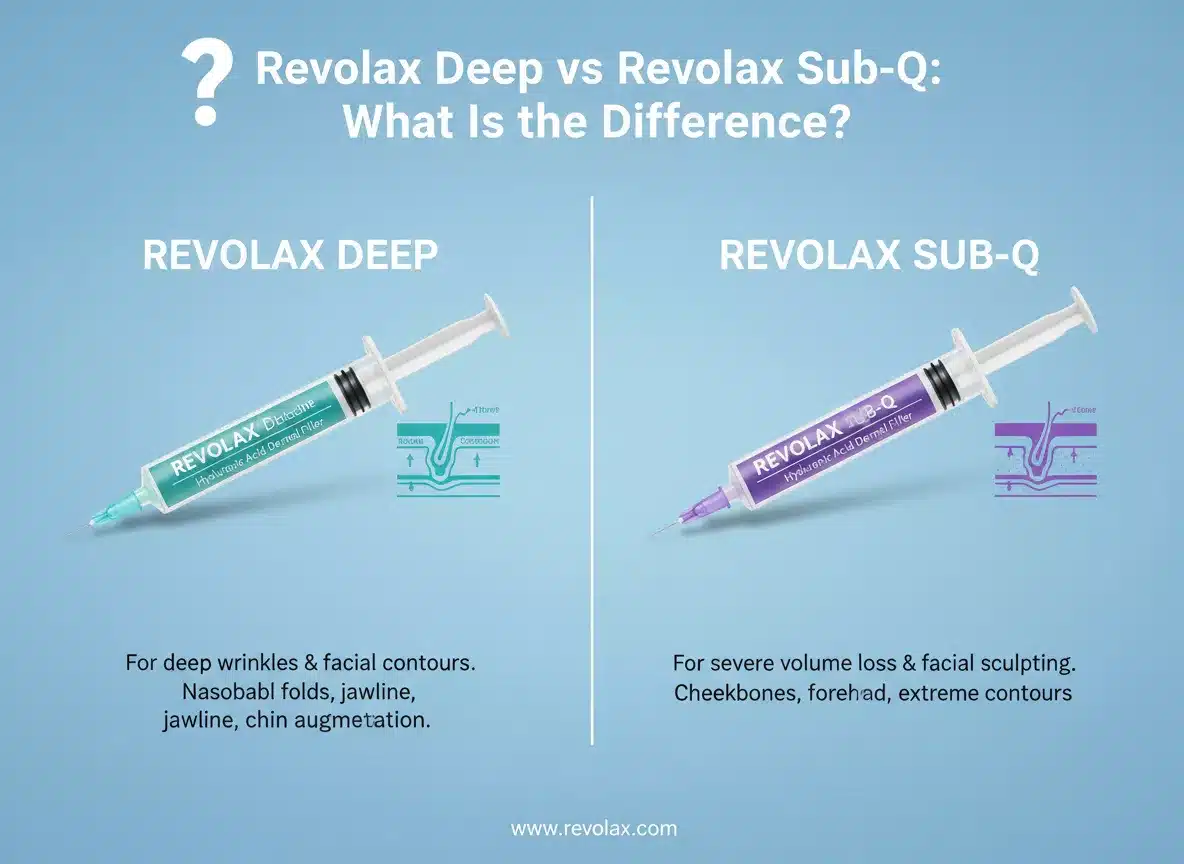
Revolax Deep and Revolax Sub-Q share the same hyaluronic acid concentration but are built for different depths and different jobs. Sub-Q is the thicker, higher-viscosity option designed for deep structural volume in areas like the cheeks and chin, while Deep sits one layer up, suited to the mid-to-deep dermis for folds and lip augmentation. Picking the wrong one for the wrong layer is the most common mistake practitioners make with this range.
What Is Revolax Deep Used For?
Revolax Deep is a monophasic, cross-linked hyaluronic acid filler formulated at 24mg/ml, supplied in 1.1ml syringes with 0.3% lidocaine for patient comfort. It’s designed for mid-to-deep dermal placement, making it a common choice for moderate nasolabial folds, lip augmentation and general volume support in the mid-face.
Results from Revolax Deep commonly last twelve to eighteen months, depending on the treatment area and the individual’s metabolism. Because it sits one layer up from Sub-Q, it behaves more predictably in areas with finer movement, like the lips, without feeling as dense or structural.
What Is Revolax Sub-Q Used For?
Revolax Sub-Q is the thickest and most viscous product in the range, also formulated at 24mg/ml of hyaluronic acid but with a denser cross-linked structure designed for deep tissue and volumising injections. It’s typically reserved for the cheeks, chin and jawline, where a stronger, more structural lift is the goal.
Its density means Sub-Q holds its shape and position well once placed, which is why many experienced injectors prefer it over Deep specifically for facial contouring and volume replacement in the lower and mid-face. Like Deep, it commonly lasts in the region of twelve to eighteen months.
Which Revolax Filler Is Thicker?
Sub-Q is unambiguously the thicker and more viscous of the two, formulated with a larger particle size and denser cross-linking to hold structure in deep tissue. Deep sits in the middle of the range, thicker than Revolax Fine but noticeably less dense than Sub-Q.
- Revolax Fine: lowest viscosity, superficial dermis, fine lines
- Revolax Deep: mid-viscosity, mid-to-deep dermis, folds and lips
- Revolax Sub-Q: highest viscosity, deep tissue, cheeks, chin and jawline
Which Is Best for Facial Contouring?
For structural facial contouring, cheek volumisation, jawline definition and chin projection, Sub-Q is generally the stronger choice because its density and viscosity are built specifically to hold shape under the greater tissue pressure of these deeper planes.
Deep can still play a role in contouring where a softer, less structural volume change is wanted, or where it’s used to blend and soften the transition between a Sub-Q placement and the surrounding tissue.
Which Is Best for Cheeks?
Sub-Q is the more commonly recommended option for cheek augmentation among experienced injectors, precisely because its molecular structure and viscosity suit the deep tissue plane where cheek volume is typically restored.
Deep isn’t unsuitable for the cheeks in every case, but most practitioners reach for the denser product when the primary goal is structural volume rather than a softer, more superficial correction.
How Do You Choose Between Revolax Deep and Sub-Q?
The decision comes down to treatment depth and goal rather than personal preference alone. If the target is a fold or area needing moderate volume in the mid-to-deep dermis, such as nasolabial folds or lip augmentation, Deep is the appropriate choice.
If the goal is deeper structural support, cheek volume, jawline definition or chin projection, Sub-Q’s higher viscosity and denser cross-linking make it the more suitable product. Matching product viscosity to the correct tissue layer, rather than defaulting to one product across every treatment area, is the single most important decision an injector makes with this range.
Are Revolax Fillers Reversible?
Yes. Both Revolax Deep and Revolax Sub-Q are hyaluronic acid based, which means they can be dissolved with hyaluronidase if a correction is needed, whether because of an aesthetic concern, an uneven result, or a rare vascular complication requiring urgent reversal.
This reversibility is one of the standing safety advantages of HA fillers as a category, and it’s worth confirming as part of any patient consultation, since it materially changes the risk conversation compared with older, non-reversible filler materials that are no longer in common use.
What Should Clinics Check Before Stocking Either Product?
Batch documentation and CE marking should be confirmed for every order, not just the first, since counterfeit and diverted stock has been a recurring problem for popular Korean HA filler brands sold through unverified channels. A genuine UK wholesale supplier should be able to provide full traceability back to the manufacturer without hesitation.
It’s also worth confirming current storage guidance directly from the supplier, since HA fillers generally need to be kept within a specified temperature range to maintain their structure and performance, and a product that’s been mishandled in transit or storage can behave unpredictably regardless of which grade in the range it is.
Frequently Asked Questions
Direct answers to the comparison questions that come up most often about the Revolax range.
What is Revolax Deep used for?
Moderate nasolabial folds, lip augmentation and general mid-face volume support in the mid-to-deep dermis.
What is Revolax Sub-Q used for?
Deep structural volume in the cheeks, chin and jawline, where a denser, higher-viscosity product is needed.
Which Revolax filler is best for cheeks?
Sub-Q, for most practitioners, due to its density and viscosity suited to deep tissue.
Which Revolax filler is best for facial contouring?
Sub-Q for structural contouring; Deep for softer blending or moderate volume needs.
Which Revolax filler is thicker?
Sub-Q is the thickest and most viscous product in the range.
How long does Revolax Deep last?
Commonly twelve to eighteen months, depending on the area and individual.
How long does Revolax Sub-Q last?
Also commonly twelve to eighteen months.
What is the difference between Revolax Deep, Fine and Sub-Q?
All three share the same 24mg/ml HA concentration; they differ in cross-linking density and viscosity, which determines the tissue layer and treatment goal each is suited to.