Cannula vs Needle: 7 Key Differences Clinics Should Know (2026)
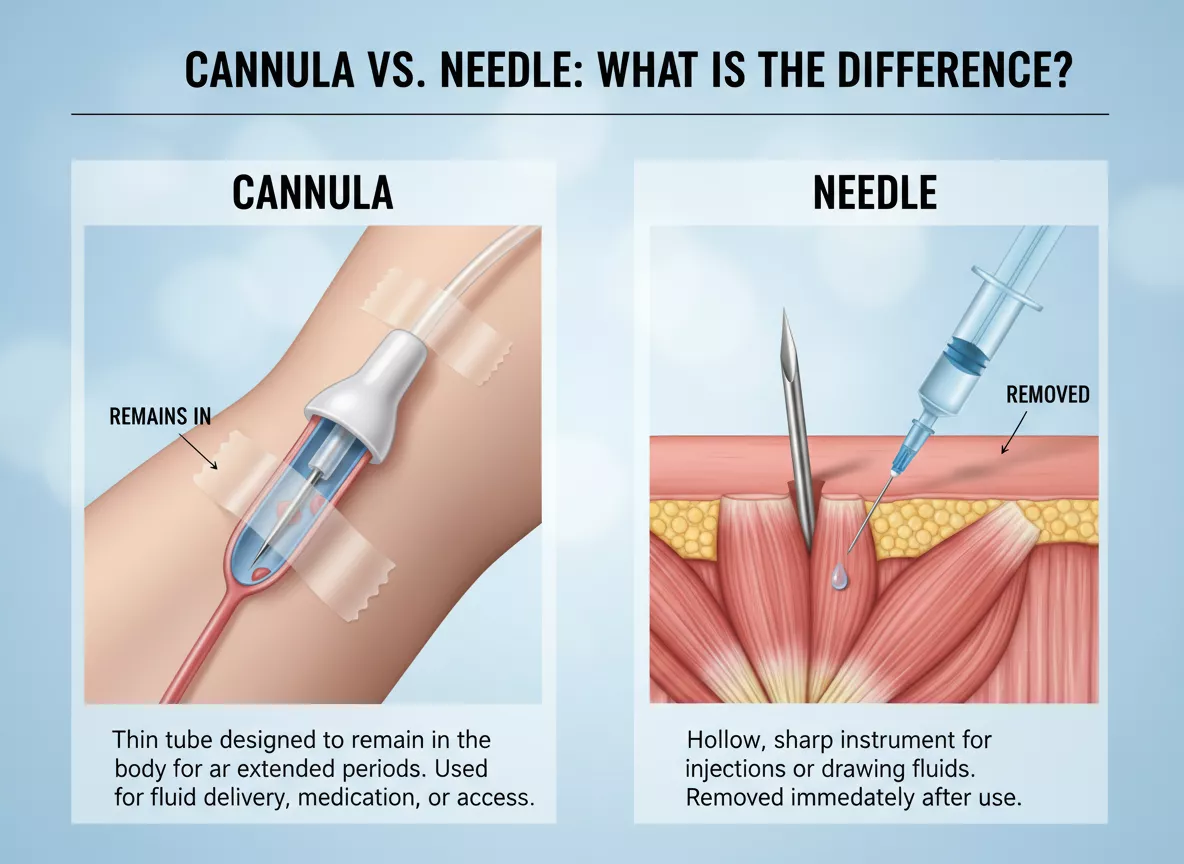
When it comes to cannula vs needle injection technique, the core difference sits entirely at the tip: a needle has a sharp, bevelled point designed to pierce tissue directly, while a cannula has a blunt, rounded tip designed to glide past structures like blood vessels rather than puncture them. That single design difference drives the 7 key distinctions below — everything a clinic needs to know when deciding which device to use in dermal filler treatments.
1. Tip Design: The Root of the Cannula vs Needle Difference
A needle’s bevelled point is built to pierce; a cannula’s rounded, blunt tip is built to glide past structures like blood vessels rather than cut through them. This single design choice is the reason every other difference on this list exists.
2. Vascular Occlusion Risk
For most filler treatments in vessel-dense areas of the face, cannulas are generally considered the safer option, backed by published clinical data. A 2021 study in JAMA Dermatology, drawing on data from 370 board-certified dermatologists, recorded a vascular occlusion rate of 1 in 6,410 injections with needles versus 1 in 40,882 with cannulas — roughly a six-fold difference.
Better isn’t absolute, though. In the cannula vs needle comparison, needles retain real advantages for precision work, fine lines, and specific bolus placement directly on bone, so the honest answer is that each device suits different situations rather than one simply replacing the other.
3. Bruising and Recovery Time
The primary reason practitioners lean toward a cannula in the cannula vs needle decision is reduced trauma. A cannula’s blunt tip tends to deflect soft tissue and blood vessels rather than cutting through them, which is reflected in consistently lower rates of bruising reported across clinical studies, with reductions in the range of 30 to 60 percent compared with needle injection in some published comparisons.
- Lower vascular occlusion risk in vessel-dense areas, supported by published data
- Reduced bruising and faster patient recovery
- Fewer skin entry points needed to cover a treatment area
- Smoother, more even product distribution through a fanning technique
4. Precision: Where Needles Still Win
Needles remain the better tool for precise, focal placement — particularly for very fine lines, direct bolus injection onto bone or ligamentous structures, and treatments where exact depth control matters more than covering a wide area from one entry point.
Some practitioners also use needles for specific anatomical landmarks like the vermillion border or cupid’s bow, where a cannula’s blunt tip makes it harder to achieve the same sharp, defined placement that a needle allows. This is one of the clearest practical splits in the cannula vs needle debate.
5. Gauge and Entry Points
A blunt-tip cannula is a flexible, rounded-end injection device, typically made of surgical steel, inserted through a single small entry point created with a needle, then used to fan out across a wider treatment area. A needle, by contrast, typically requires a fresh entry point for each injection site.
Cannulas are supplied in a range of gauges and lengths to suit different products and treatment areas, with a smaller gauge number indicating a larger diameter — the same convention used for needles.
6. Treatment Area Suitability
Not every treatment suits a cannula. Cannulas work well across most face and body areas, but some very fine or highly localised treatments, such as filling a specific superficial line, are more effectively and precisely delivered with a needle.
The choice ultimately reflects a balance between the safety advantage of a cannula and the precision advantage of a needle, and many practitioners use both within the same treatment session depending on the specific area being addressed.
7. How Practitioners Actually Choose Between the Two
The cannula vs needle decision generally follows the anatomy of the treatment area. Vessel-dense, higher-risk zones such as the temples, prezygomatic space and nasolabial folds are commonly treated with a cannula, while precise, low-risk superficial work is more often suited to a needle.
Practitioner training and comfort also play a genuine role. A well-trained injector using a needle with excellent anatomical knowledge and careful technique can still achieve a very safe outcome, since technique and anatomical understanding influence risk as much as the device itself.
What Does the Wider Evidence Actually Show?
A narrative review published in JPRAS Open synthesised evidence from randomised controlled trials, observational studies and cadaveric anatomical work comparing the two devices, concluding that cannulas are associated with lower rates of bruising and a reduced signal for vascular occlusion in high-risk, vessel-dense regions, while also improving patient comfort and downtime.
The same review is careful to note that cannulas aren’t inherently risk-free. Arterial wall penetration and ischemic events remain possible with improper plane selection, excessive injection pressure, or inadequate anatomical control, and some studies comparing arterial wall penetration force found that a similar force could pierce a vessel with either a needle or a cannula of the same gauge. The consistent message across the literature is that device choice modifies risk, but anatomy and technique still do most of the work.
Does Training Matter More Than the Device Itself?
The published literature increasingly frames the cannula vs needle question as a false choice. Clinicians presenting at aesthetic conferences have described the debate as best resolved by combining both tools — using a cannula for broad, minimally traumatic contouring and a needle for precise shaping — rather than treating either device as a universal answer on its own.
For a clinic building its own protocols, that means investing in anatomical training and technique refinement alongside stocking both devices, rather than assuming that switching to cannulas alone is sufficient to eliminate vascular risk. The equipment supports good technique; it doesn’t replace it. Whichever way your clinic leans on the cannula vs needle question, both devices belong in a well-stocked treatment room — you can browse cannulas and needles alongside your filler range.
Frequently Asked Questions
Straightforward answers to the questions clinics and practitioners ask most often about cannula vs needle technique.
Is a cannula better than a needle for dermal fillers? Generally safer in vessel-dense areas based on published data, though needles retain advantages for precision work.
Why do practitioners use cannulas for fillers? Primarily reduced vascular occlusion risk and less bruising, supported by clinical studies.
When are needles used instead of cannulas? For fine lines, bolus placement on bone, and precise anatomical landmarks like the vermillion border.
What is a blunt-tip cannula? A flexible, rounded-end device designed to glide through tissue rather than pierce it.
What size cannula is used for fillers? Typically 22G to 27G, depending on the treatment area and product viscosity.
What gauge needle is used for dermal fillers? Commonly 27G to 30G, depending on the filler’s viscosity and the treatment area.
Can cannulas be used for all filler treatments? Not universally; some fine or highly localised work is better suited to a needle.
Are cannulas single-use? Yes, all cannulas should be sterile, single-use devices disposed of as clinical sharps waste.
Weighing up cannula vs needle for your next order? Browse our range of dermal fillers, or read our guide on how to buy dermal fillers UK-wide for sourcing tips.