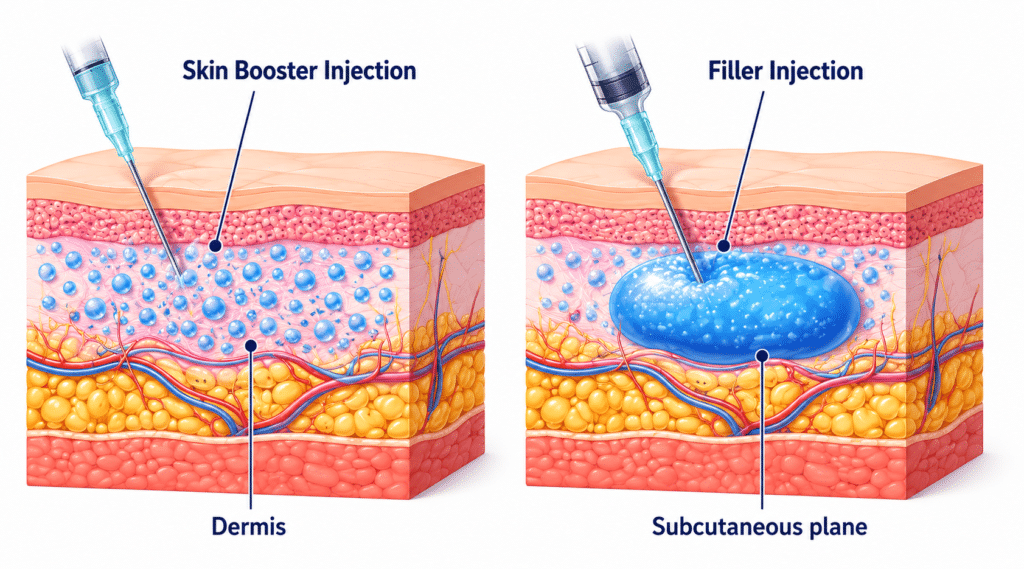
In contemporary aesthetic medicine, successful facial rejuvenation increasingly depends on a precise understanding of both structural support and skin quality. Patients rarely present with isolated volume loss or isolated dehydration; most exhibit a combination. Mastering the difference between filler and skin booster enables practitioners to select the right tool or combination for each individual, optimising outcomes while managing expectations and minimising risk.At the heart of this distinction lies the science of hyaluronic acid (HA) and how its molecular architecture is engineered: crosslinked versus noncrosslinked (or hybrid stabilised) forms. This foundational difference in rheology, degradation profile, and biological behaviour drives everything from injection technique and depth to clinical indication, longevity, and patient selection. The Foundational Science: Crosslinked vs Noncrosslinked Hyaluronic Acid Native HA in the dermis is a linear, noncrosslinked glycosaminoglycan that binds up to 1000 times...