Profhilo vs Polynucleotides: Which Is Better?
Neither treatment beats the other outright, and any supplier telling you otherwise is oversimplifying. Profhilo remodels skin through concentrated hyaluronic acid, while polynucleotides work by activating fibroblasts directly at a cellular level. The right choice depends on what the client’s skin actually needs: fast hydration and lift, or slower structural repair. Most UK clinics that have used both end up stocking each for a different conversation.
What Is Profhilo?
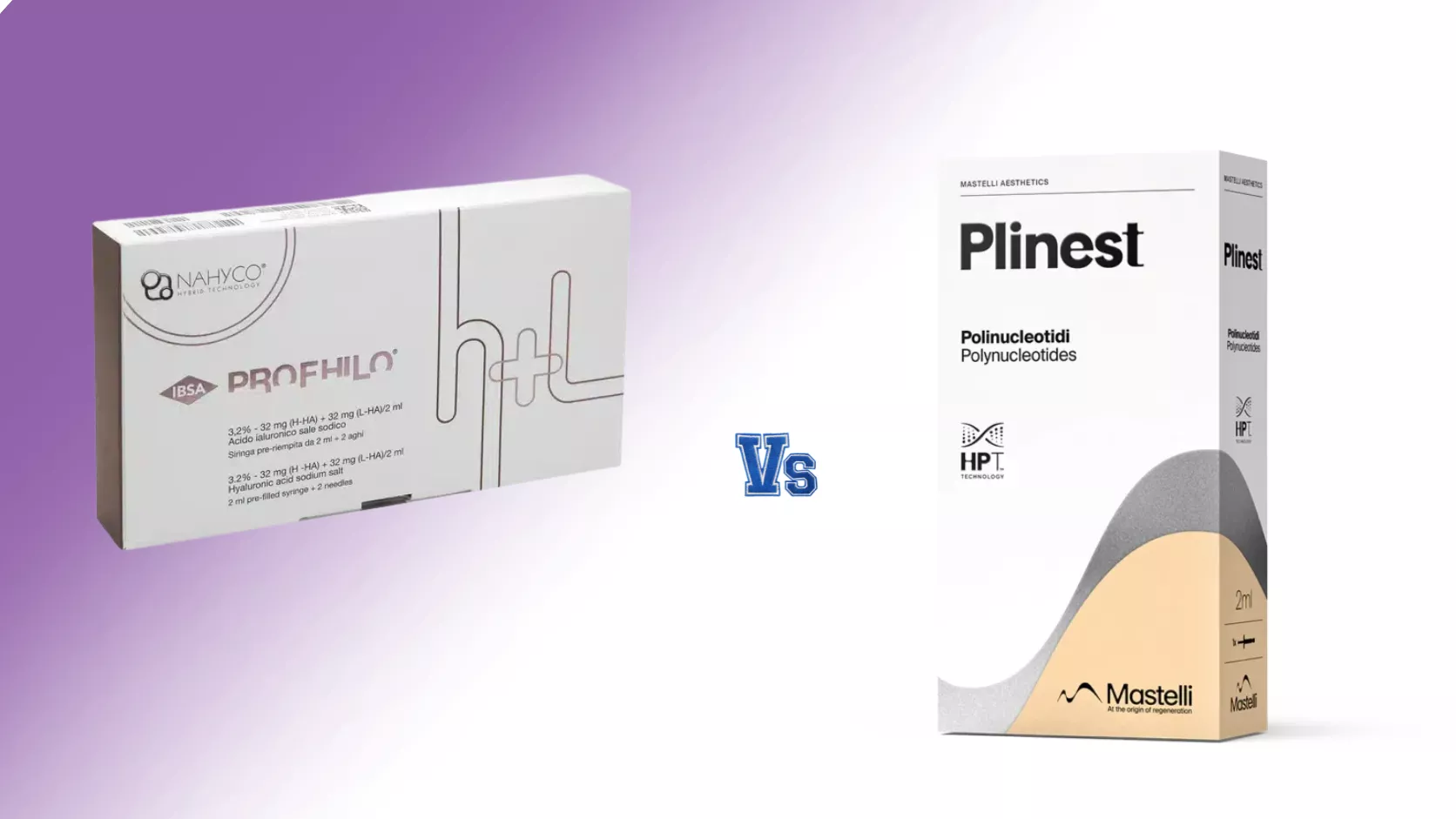
Profhilo is a bio-remodelling injectable made by IBSA, built from a hybrid of high and low molecular weight hyaluronic acid bonded through a patented thermal process rather than the chemical cross-linking (BDDE) used in most dermal fillers. That absence of a cross-linking agent is the whole point of the product. Once injected, it doesn’t sit in place and hold a shape; it spreads through the tissue and pulls water into the dermis from within.
The standard protocol is two sessions spaced four weeks apart, delivered at five injection points on each side of the face using what’s known as the BAP technique. Clients typically notice hydration improve within days, with collagen and elastin gains building over six to eight weeks as the bio-remodelling effect takes hold. Maintenance sessions sit at roughly every six months once the initial course is complete.
What Are Polynucleotides?
Polynucleotides, usually shortened to PN, are purified fragments of DNA taken from salmon or trout and filtered to remove anything that could trigger an immune reaction. Brand names available to UK clinics include Plinest, Newest, Rejuran and Vitaran, each with its own concentration and formulation. What matters clinically is the shared ingredient: fragments of DNA that the body reads as a signal to repair, not simply a substance to absorb.
Once in the dermis, polynucleotides are taken up by fibroblasts and activate the adenosine A2A receptor pathway, the same mechanism studied in wound healing for over two decades before it made its way into aesthetics. That activation triggers fresh collagen and elastin production alongside a measurable drop in local inflammation. It’s a slower, more foundational process than simple hydration, and the results reflect that timeline.
How Do the Two Treatments Actually Work?
Profhilo’s action is largely physical and chemical. A dense reservoir of hyaluronic acid draws water into the tissue while the hybrid complex resists breakdown by hyaluronidase for longer than ordinary HA would. The lifting and plumping effect follows fairly directly from that hydration, which is why results appear quickly.
Polynucleotides work through cell signalling instead of water-binding. The DNA fragments don’t add bulk or moisture on their own; they wake up fibroblasts and push them to build new tissue from the ground up. This is why practitioners often describe PN as a cell activator rather than a hydrator, and why results take longer to show but tend to address more structural concerns like laxity and photodamage.
Profhilo vs Polynucleotides: Longevity Compared
Profhilo results generally hold for around six months before a top-up session becomes necessary, a figure that’s fairly consistent across UK clinic protocols and manufacturer guidance. The effect fades gradually as the hyaluronic acid is metabolised, so clients rarely notice a sharp drop-off in results.
Polynucleotides tend to last a little longer in real-world use, with many clinics quoting results of up to nine months for brands like Vitaran. That extra longevity comes down to mechanism: PN triggers ongoing collagen synthesis rather than relying on a reservoir of product that simply depletes over time.
Which Is Better for Mature Skin?
Mature skin with significant laxity, fine lines and reduced elasticity tends to respond well to polynucleotides, because the treatment addresses the underlying loss of collagen rather than just topping up hydration on top of it. Clients in their fifties and sixties with visible photodamage are often steered toward a PN course as the starting point.
Profhilo still has a place here, particularly for clients whose main complaint is dullness and dehydration rather than deep structural change. In practice, many experienced injectors run a course of polynucleotides first to rebuild tissue quality, then maintain that result with Profhilo between sessions.
Which Is Better for Under-Eye Skin?
The periorbital area is thin, mobile and unforgiving of the wrong product, which rules out most standard-strength formulations designed for the cheeks or forehead. Purpose-built under-eye products exist in the polynucleotide category, including Vitaran Eyes, formulated at lower volumes specifically for precise placement in this zone.
- Profhilo isn’t marketed or licensed specifically for direct periorbital placement
- PN eye-specific products are formulated at lower concentration and volume for this thin tissue
- Product choice under the eyes should always follow the manufacturer’s stated indication for that area
Can Profhilo and Polynucleotides Be Used Together?
Yes, and it’s become an increasingly common protocol rather than an either-or decision at UK clinics. Practitioners often run a polynucleotide course first to rebuild collagen and calm inflammation, then layer Profhilo on top for the hydration and lift that clients notice fastest.
Combining the two isn’t a shortcut, though, and each product should be dosed and spaced according to its own protocol rather than mixed arbitrarily in the same session. Always check the current SmPC or IFU for each product before combining treatments for a specific client.
How Many Treatments Are Usually Needed?
Profhilo follows a well-established two-session protocol, spaced four weeks apart, with maintenance roughly every six months after that. This is one of the more standardised parts of the treatment and rarely varies much between clinics.
Polynucleotide courses run slightly longer, typically two to three sessions spaced two to four weeks apart depending on the brand and concentration used. Results build cumulatively across the course, so clients should be told upfront that visible change after a single session is usually modest.
Frequently Asked Questions
These questions come up constantly in clinic consultations and supplier enquiries. The answers below are kept short and specific, the kind of information a practitioner or a curious client can act on immediately.
They’re often grouped under the skin booster umbrella because both categories improve overall skin quality rather than adding volume, but PN works through cell activation while classic skin boosters work through hydration.
Polynucleotides tend to last a little longer in practice, up to nine months for some brands, against roughly six months for Profhilo.
Yes, and combining them is increasingly common, usually with a PN course first for structural repair followed by Profhilo for hydration and maintenance.
Polynucleotides, generally, since they address collagen loss directly. Profhilo suits clients whose main concern is dehydration rather than deep structural change.
Dedicated PN eye formulations, since they’re built for the low-volume, precise injection this delicate area needs.
Profhilo: two sessions, four weeks apart. Polynucleotides: two to three sessions, spaced two to four weeks apart.
Profhilo delivers faster, more immediate hydration due to its high HA concentration; polynucleotides improve hydration more gradually as tissue quality improves.