What Are Polynucleotides and How Do They Work?
Polynucleotides are purified fragments of DNA, most often sourced from salmon or trout, used in aesthetic medicine to stimulate the skin’s own repair processes. Once injected, they activate fibroblasts and trigger fresh collagen and elastin production rather than simply adding hydration. UK brands include Plinest, Vitaran, Newest and Rejuran, each a variation on the same core technology.
What Are Polynucleotides, Exactly?
The raw material is DNA extracted from fish, most commonly salmon or trout, chosen because it shares a high degree of biological compatibility with human tissue. Manufacturers put it through an extensive purification process to strip out proteins and other material that could trigger an immune reaction, leaving behind sterile, biologically active DNA fragments.
The finished product is sometimes called PDRN, short for polydeoxyribonucleotide, and the terms polynucleotide, PDRN and salmon DNA are used fairly interchangeably across the UK aesthetics market. What actually varies between brands is chain length, concentration and purification method, which is why Plinest, Vitaran and Rejuran aren’t clinically identical despite sharing the same underlying ingredient.
How Do Polynucleotides Work in the Skin?
Once injected into the dermis, the DNA fragments are absorbed by fibroblasts, the cells responsible for producing collagen and elastin. This uptake activates the adenosine A2A receptor pathway, a mechanism studied in wound healing for over two decades before it found its way into aesthetic medicine.
That activation does three things at once: it calms local inflammation, improves microcirculation, and pushes fibroblasts to produce fresh structural protein. The combined effect is skin that gradually becomes thicker, more elastic and better hydrated, rather than an instant plumping effect appearing overnight.
Polynucleotides vs Hyaluronic Acid: What’s the Difference?
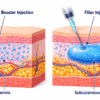
Hyaluronic acid, whether in a filler or a skin booster like Profhilo, works largely by physically drawing water into the tissue. It’s a hydration and volume mechanism, effective and fast-acting, but it doesn’t directly instruct cells to build new collagen on its own.
Polynucleotides take a different route entirely. Rather than adding a substance the tissue simply holds onto, they send a biochemical signal that gets the skin’s own repair machinery working. That’s a slower process, but many practitioners consider it more foundational, since it addresses the cellular activity behind ageing rather than just its visible symptoms.
Are Polynucleotides the Same as Skin Boosters?
Not quite, though the terms overlap in everyday use. Skin booster is a broad category that includes HA-based hydrating injectables like Profhilo and Seventy Hyal, and many suppliers also file polynucleotides under the same umbrella because both improve skin quality without adding volume.
- Skin boosters (HA-based): hydrate through water-binding, fast visible results, no direct collagen-stimulating signal
- Polynucleotides: cell-signalling mechanism, slower onset, structural improvement through fresh collagen and elastin synthesis
- Both fall outside the definition of a dermal filler, since neither is designed to add shape or volume to a feature
What Areas Can Be Treated With Polynucleotides?
The face is the most common treatment area, covering general skin quality, fine lines and early laxity, but polynucleotides aren’t limited to it. Formulations exist specifically for the under-eye area, the neck and décolletage, the scalp for hair density support, and the body for skin laxity after weight loss.
Product choice should always follow the area being treated. A general full-face formulation isn’t automatically suitable for the eye or scalp, since concentration, volume and injection depth differ by indication, and manufacturers publish area-specific guidance for exactly this reason.
Are Polynucleotides Suitable for All Skin Types?
Clinical use across a wide range of skin types and tones has generally been well-tolerated, and the treatment doesn’t rely on pigment-sensitive mechanisms the way some laser or light-based treatments do. That makes it a reasonably versatile option across a diverse UK client base, including skin types that are harder to treat safely with heat or light-based devices.
As with any injectable, individual suitability still depends on a proper consultation covering allergies, current medication, skin condition and treatment history. Fish-derived products carry an obvious contraindication for clients with a genuine fish or seafood allergy, which should be screened for at consultation stage every time, along with pregnancy, active skin infection in the treatment area, and any known bleeding disorder.
How Long Do Results Last, and How Many Sessions Are Needed?
A typical course runs two to three sessions, spaced two to four weeks apart, with visible improvement building progressively rather than appearing after the first visit. Most clients start noticing a difference from the second session, with fuller results settling in around four to six weeks after the final one.
Longevity varies by brand and area, but results commonly last six to nine months before a top-up course is needed. That’s a slightly longer window than most HA-based skin boosters, largely because the treatment triggers ongoing collagen production rather than depending on a product reservoir that simply depletes over time.
Are Polynucleotides Better Than Profhilo?
Better depends entirely on what the skin needs. Profhilo wins on speed, with visible hydration improvement within days, and on a straightforward, well-established protocol. Polynucleotides win on addressing structural, cellular-level ageing, particularly in skin with genuine laxity or photodamage.
Increasingly, UK clinics aren’t choosing one over the other at all. A combination protocol using polynucleotides for structural rebuilding and Profhilo for maintenance hydration is becoming a standard part of the skin quality menu at practices that stock both.
Frequently Asked Questions
These are the questions clinics and clients ask most often once they’ve grasped the basic mechanism behind the treatment.
Improving overall skin quality, hydration, elasticity and fine lines through collagen and elastin stimulation, on the face, under the eyes, neck, scalp and body.
They overlap in classification, but PN works through cell signalling while classic HA skin boosters work through hydration alone.
Neither is universally better; PN suits structural, cellular-level concerns, while Profhilo suits faster hydration needs. Many clinics use both.
Commonly six to nine months, depending on the brand, concentration and area treated.
Most protocols run two to three sessions, spaced two to four weeks apart.
Generally yes, though clients with a genuine fish or seafood allergy should be screened out at consultation.
The face, under-eye area, neck, décolletage, scalp and body, each requiring a product formulated for that specific indication.
HA hydrates by drawing in water; polynucleotides signal fibroblasts to build new collagen and elastin, a slower but more structural process.